Before the Fall: What History of Capitalism Reveals About Techno-Feudalism?
-Mustafa Burak Avcı
“Capitalism is inherently rooted in human nature,” forming the basis of the classical school of economics. This view posits that capitalism is distinguished by its focus on rational profit maximization, based on the belief that humans are intelligent beings who consider potential gains in all actions.
Recently, questions such as “Where is humanity headed?” and “Is capitalism ending?” are being addressed through a new framework called Techno-Feudalism or Neo-Feudalism. As technological progress, including AI, robotics, and internet infrastructure, becomes deeply integrated into daily life, discussions of universal basic income are often paired with dystopian visions from Big Tech. Even critical studies supporting this framework suggest capitalism’s demise. Nonetheless, many other works focus on capitalism’s emergence, growth, and crises. Certainly, before dismantling capitalism, it is essential to ask, “How did capitalism originate?” This question offers crucial insight into the story of capitalism’s demise. Nevertheless, answering it is challenging. Even after centuries, there is no consensus in social and economic sciences, and it remains a focus of significant research.
While various answers exist, two main perspectives are often introduced. The first argues that “Capitalism is inherently rooted in human nature” forming the basis of the classical school of economics. This view posits that capitalism is distinguished by its focus on rational profit maximization (RCT Theory), based on the belief that humans are intelligent beings who consider potential gains in all actions. It also suggests that capitalism, by seeking to enhance labor productivity through technological means, assumes that humans will naturally choose the most efficient methods, which it regards as an instinct. These ideas are grounded in Enlightenment notions of progress, which view humanity’s ongoing enlightenment as culminating in humans’ realization of their true nature. Until then, humans have faced significant challenges, with the development of capitalism seen as a process of overcoming these obstacles. Evidence for this perspective includes technological advances since Homo sapiens first used tools and historical exchange of material commodities.
This perspective suggests that capitalism has no point of origin. While human nature continues to exist, it must transcend its constraints -such as those from Feudalism- to mature. These constraints are often political: feudal lords, parasitic powers, culture, and religion. Regulations that hinder human nature constrain the growth of “economic” agents. So, even after humanity’s goal of globalization and the transformation of economic agents into regulators, why do traces of feudalism re-emerge under the guise of Techno-Feudalism?
A second perspective emerges from a critical view on capitalism, rooted in Marx’s foundational work, Zur Kritik der politischen Ökonomie (Contribution to the Critique of Political Economy, 1859). Marx’s critique highlighted that wealth is not inherently capital; rather, capital represents a specific social relation. This suggests that wealth accumulation alone did not directly lead to capitalism’s rise, as capital is more than just wealth or profit; it is a form of social relationship. Consequently, capitalism’s origins are not solely tied to accumulation. In contrast to other theories, this view implies that humans are not inherently driven by profit maximization or productivity.
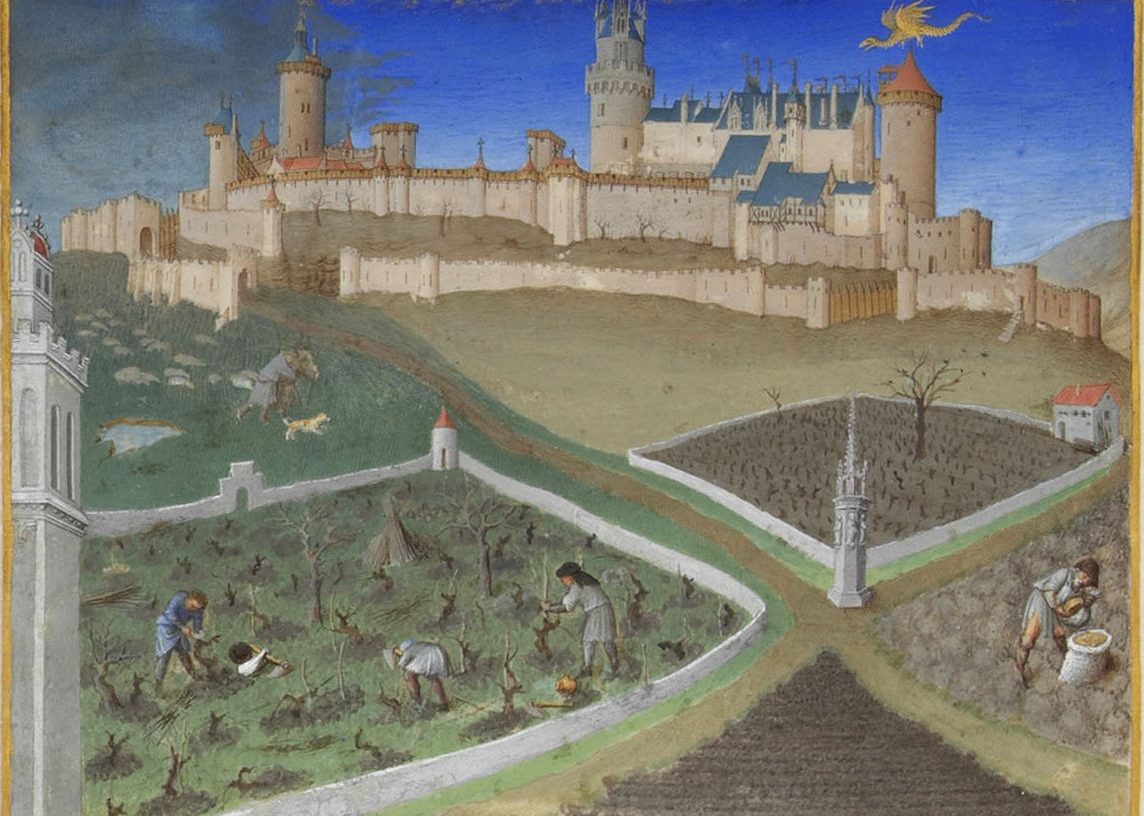
Capitalism and its social relations drove humans to seek maximum profit. It was not human nature that turned wealth into capital, but social property transformations that created the laws of capitalist movement unprecedented in history. In a changing world, competition, profit maximization, and the re-creation of surplus value necessitated constant workforce growth and development. This law of movement was unique to this era. Hence, capitalism was both a historical beginning and a finite process, neither inevitable nor the end of history. Techno-feudalism might have risen from capitalism’s ashes, altering social property relations and redefining humans as social beings. Ultimately, capitalism, like feudalism, could lose its specific laws. So, how did feudalism dissolve? Ellen Meiksins Wood, an American political theorist and historian, explains that feudalism was a specific mode of production where the economy and political authority were closely linked. Unlike capitalism, this system relied on non-economic coercive methods to extract surplus value. Peasants, often near castles for safety and market access, had direct access to land, allowing them to acquire surplus agricultural and craft products through military force. As states expanded, cities grew, and transportation improved, societal control increased. Over time, political pressure on serfdom decreased, with military power centralizing in absolutist states or large kingdoms and empires. For instance, English landowners moved from forcibly extracting surplus to renting land within competitive markets. Enclosures displaced peasants, ending subsistence farming and forcing them into a working-class role where they had to sell their labor to survive.
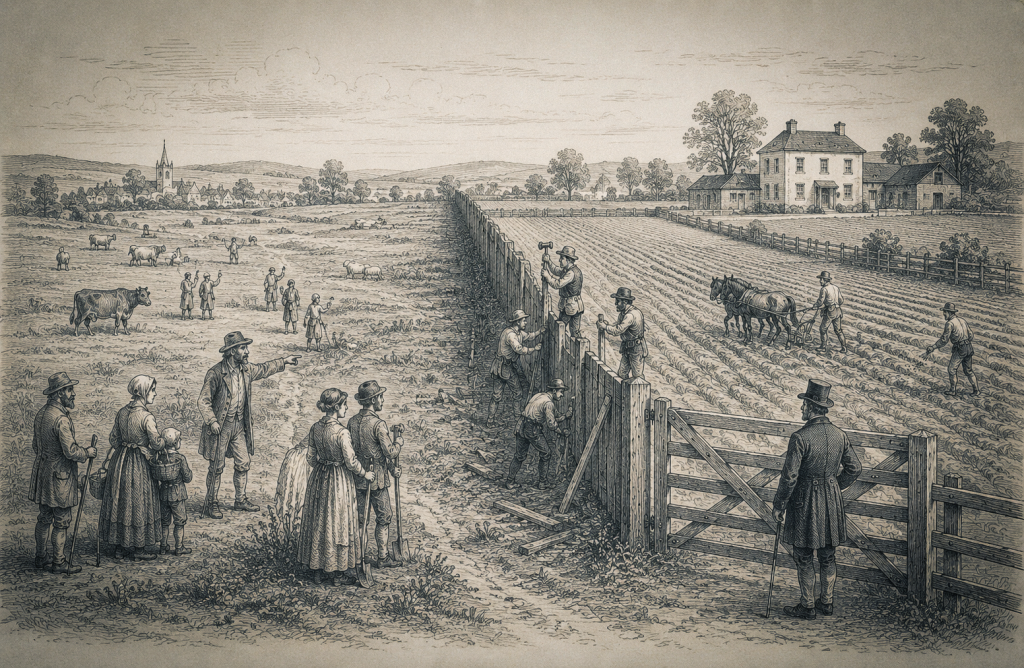
Illustration depicting the Enclosure Movement and the displacement of peasants from common lands, marking the transition to capitalism.
Now, exploitation shifted from the lord’s sword to the cold, invisible mechanisms of the market. The division between the economic and political spheres brought about changes in social relations. Dispossessed peasants developed a rational market-based economy to survive. Capitalism, emerging within its unique historical context, quickly expanded into a global economy.
“For instance, English landowners moved from forcibly extracting surplus to renting land within competitive markets. Enclosures displaced peasants, ending subsistence farming and forcing them into a workingclass role where they had to sell their labor to survive.”
Immanuel Wallerstein, an American sociologist renowned for his work in historical sociology and developing world-systems theory, argued that feudalism would end just as it had arisen. He theorized that every system is born, runs its natural cycle, and eventually, because of structural contradictions, enters a permanent crisis phase. The modern world-system, which emerged from the crisis of feudalism, is based on a vast network characterized by unequal exchange between the core and peripheral nations. While earlier capitalism overcame stagnation through territorial expansion, it can no longer do so in today’s highly developed global economy, having reached its mathematical limits. Factors such as rising labor costs from declining rural populations, ecological costs from exhausted natural resources, and growing tax burdens on education and healthcare contributed to this stagnation. The crisis became evident as overall profit rates shrank, pushing capitalism toward a breaking point, as Wallerstein noted in The End of the Known World.
The initial response of capital to the prolonged decline in the system’s profit rates was the rise of Neo-liberalism. However, as the bottleneck in production continued, capital shifted toward financial speculation. Instead of expanding through production, capital began to grow through finance. This unsustainable system collapsed during the 2008 Global Financial Crisis. To rescue the system, central banks printed trillions of dollars of fiat money. Since there were no profit expectations in finance, this influx directly inflated technology companies’ share prices, enabling significant investment in digital infrastructure.
Economist Yanis Varoufakis describes this phenomenon as the emergence of Techno-Feudalism, which diverges from traditional market mechanisms. He argues that companies funded mainly by unbacked central bank money, which dominate internet platforms, undermine capitalism’s core principles, markets, and profit mechanisms. A new feudal-like parasitic structure has emerged over production, with productive capital now dependent on these platforms.
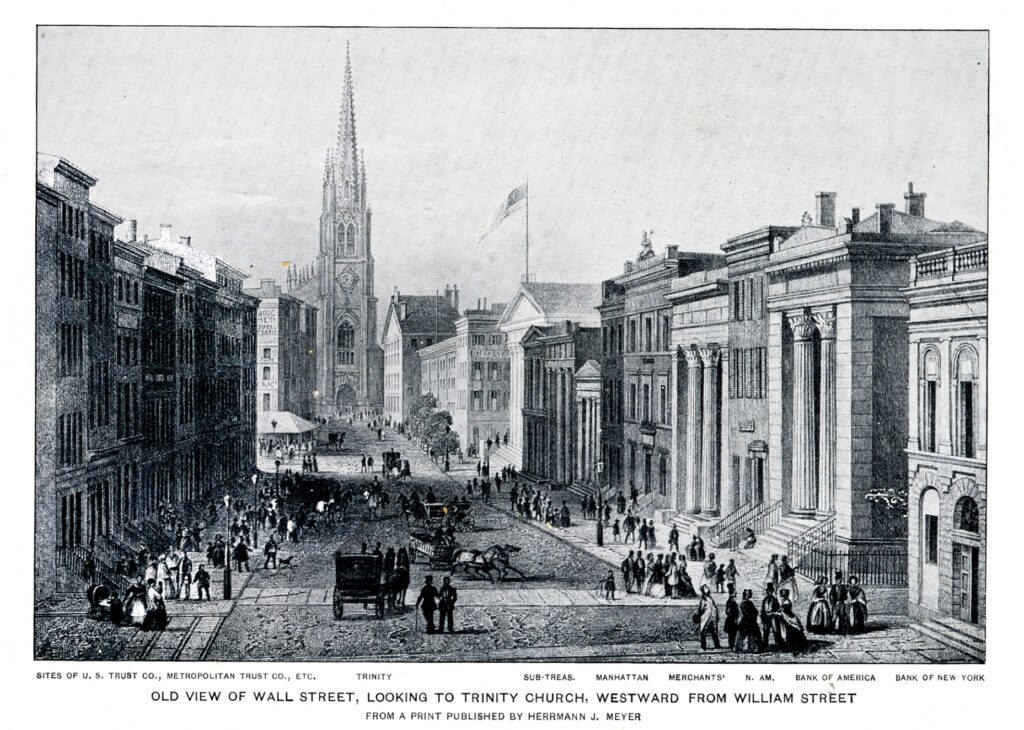
Historic view of Wall Street illustrating the rise of financial capitalism in 19th-century New York.
Financial capital clusters around them to compete and seek profit or growth. Fiber-optic cables, data centers, and A.I. systems connect the world, making productive capital reliant on these infrastructures.
“Economist Yanis Varoufakis describes this phenomenon as the emergence of Techno-Feudalism, which diverges from traditional market mechanisms. He argues that companies funded mainly by unbacked central bank money, which dominate internet platforms, undermine capitalism’s core principles, markets, and profit mechanisms. A new feudal-like parasitic structure has emerged over production, with productive capital now dependent on these platforms.”
Major corporations like Amazon, Google, Meta, and Apple now control this landscape. Platforms and algorithms dominate consumer markets, dictating choices and prices with near-absolute authority. Consequently, productive investments are reduced to rent-seeking activities, such as feudalism, in which peasants paid a share of their harvest to landowners. Today, producers and programmers often pay 30-40% of their sales as rent to platform owners. Billions of people work as digital serfs to grow cloud capital entirely voluntarily, thinking they are just having fun or socializing without any charge. Every search, share, and like trains these algorithms and provides data about consumer habits. Moreover, this cloud capital uses this data to hold our attention hostage, exploit dopamine cycles, and directly implant desires into minds, trapping them in an algorithmic hegemony. Jodi Dean, an American political scientist, notes that the once-dissolving divide between the economic and political realms of capitalism is now reversing, with the economy gaining political influence.
“Digital network owners are controlling trade, influencing free expression, and even affecting daily life, much like sovereign states. As this shift towards a Great Tech Authoritarianism unfolds, all intelligence and health data are increasingly managed by cloud capital.”
Originally seen as a democratic space, the internet now has the power to heavily influence preferences through algorithms that shape the content which users interact. Digital network owners are controlling trade, influencing free expression, and even affecting daily life, much like sovereign states. As this shift towards a Great Tech Authoritarianism unfolds, all intelligence and health data are increasingly managed by cloud capital. Today, as Wallerstein suggests, the end of the world as we know it is near. Tech-Feudalism hasn’t yet broken the fundamental laws of capitalism. It’s possible that social relations are already changing in ways we’re not noticing.
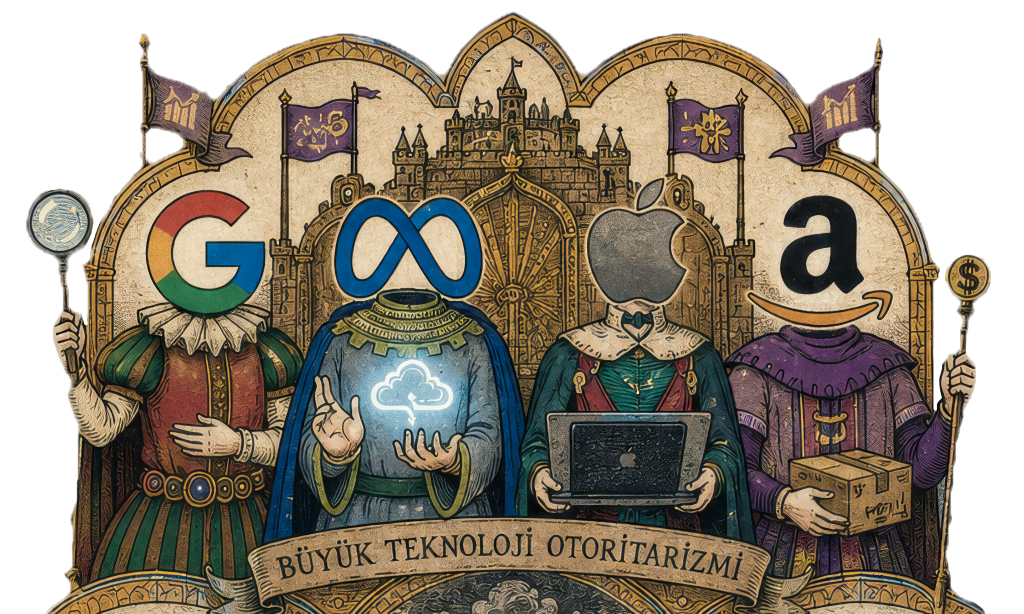
Big Tech Authoritarianism
“The initial response of capital to the prolonged decline in the system’s profit rates was the rise of Neo-liberalism. However, as the production bottleneck persisted, capital shifted toward financial speculation. Instead of expanding through production, capital began to grow through finance.”
Some studies claim that Neo-Feudalism is a natural phase of capitalism, and a significant number of people are thinking about the end of capitalism. Perhaps solutions to capitalism’s crises lie with major tech companies. Y. Varoufakis, notable for his work in this area, advocates for cyber boycotts and global strikes by mobilizing the cloud, calling on all humanity to join. He believes resistance efforts should be initiated, and the last chance to act should not be missed. We will see how it unfolds.
Son İçerikler