“The Desert of Real” Welcome Truman
Elif Başlantı
“In this realm of simulacra, the sole entity that maintains significance is Truman’s resilient mind. Christof is correct concerning one aspect: the external environment also presents numerous hazards. Indeed, the external world is not as secure as Seahaven; it is marked by chaos and uncertainty. According to Baudrillard, it is the “Desert of the Real.” Perhaps Christof’s confinement is not Seahaven itself but rather the comfortable living rooms of individuals who opt to change the channel instead of pursuing the truth and questioning their surroundings.”
“…good afternoon, good evening and good night!”
The Truman Show, which opens with this line, chronicles the life of Truman Burbank, a 30-year-old American man who has lived in a simulation since birth. This film, portraying Truman’s life broadcast live 24/7 to the world, symbolizes the loss of reality and privacy. No spontaneity or chance occurrences are allowed in Truman’s existence. Every aspect of his life is carefully orchestrated, including his encounters and conversations. His name combines “True” and “Man,” meaning “True-Man.” Interestingly, his last name, “Burbank,” is also the name of a media hub in California home to many Hollywood studios.
In a world filled with simulacra, Truman stands out as the only consciousness challenging the simulation’s limits. His name emphasizes his contradictory position within this simulated universe. In the fictional town of Seahaven where he resides, everyone is an actor devoid of true reality and emotion, merely reciting lines and performing roles to keep Truman confined within his artificial life. Despite his environment being fabricated, Truman’s feelings sadness, joy, longing, fear and his words are genuine. In Baudrillard’s view, the system relies on the innocence of the “True man” to maintain itself, mask its artificial nature, and convince viewers of a genuine truth. Humanity, adapting to its technological age, has become increasingly dependent on communication tools. The once pondered question “What is reality?” has faded into obscurity, replaced by the comfort of simulation. Baudrillard describes himself as a “theoretical terrorist,” believing that the only way to threaten the seamless machinery of modern simulation is through subversive ideas-taking meaning hostage and exposing the illusion of reality. Baudrillard’s main critique targets Disneyland, often seen as the embodiment of the American Dream. He argues that America is so fake, a literal concrete jungle, and lacking soul that it creates an entirely irrational fantasy world to keep people from questioning reality. Disneyland’s strange fictions aim to convince visitors that the outside gray city is real. When they leave this illusion and step back onto the streets, the real world seems even more authentic.
The clever tactic is to make visitors believe their gray; dull city is the real thing. Similar to how prisons make inmates feel that freedom has been lost – freedom they cannot see or reach but still know exists. People often desire what they’ve never experienced but deeply wished to. When even a faint hint of possibility arises in your mind’s deepest recesses, everything around you seems insignificant, insincere, and hollow. Disneyland was built to suppress and erase this feeling of longing. Similarly, in The Truman Show, Seahaven functions as a Disneyland created solely for Truman. Yet, Truman’s situation is much more tragic. Visitors to Disneyland see it as a simulation, and once they leave, they consider the real world as genuine. In contrast, Truman exists entirely within the simulation.
“Baudrillard argues that Truman’s world isn’t merely a lie or imitation. Imitation naturally recognizes reality’s existence and reminds us that it still exists. In this view, Truman’s life in Seahaven can be understood through Baudrillard’s ideas of simulation and simulacra.”
The primary illusion is that the outside world is real, but Disneyland aims to hide the fact that it is also a simulation. The world visitors believe to be real when they return is just as fictional as Truman’s. Baudrillard argues that Truman’s world isn’t merely a lie or imitation. Imitation naturally recognizes reality’s existence and reminds us that it still exists. In this view, Truman’s life in Seahaven can be understood through Baudrillard’s ideas of simulation and simulacra. He describes simulation as “the generation by models of a real without origin or reality,” meaning creating appearances of something that doesn’t exist, which displays all signs of reality but isn’t real itself.
A simulacrum is a copy without an original, made through this process. Acting as if there’s an original when none exists doesn’t imply Baudrillard seeks lost reality; instead, he states that reality has disappeared entirely.
Consequently, simulation gains its power from this absence, rooted in nihilism and nothingness. The question then arises: how does this hyperreal universe remain convincing? It does so through an invisible, absolute surveillance system that keeps subjects under control. Truman’s tragedy demonstrates this concept-the world around him has gone beyond mere falsehood, evolving into a hyperreal existence.
According to Baudrillard, America exists as a hyperreal universe, neither fully real nor merely a dream. This hyperreality is depicted in the film not only through dialogue but also via subtle background symbols and carefully crafted details. The initial hour feels like a continuous “Truman Show,” with viewers watching Truman on TV and their reactions reflecting our own. After this hour, the film shifts focus to “keeping Truman inside the box” and explores emerging moral dilemmas.
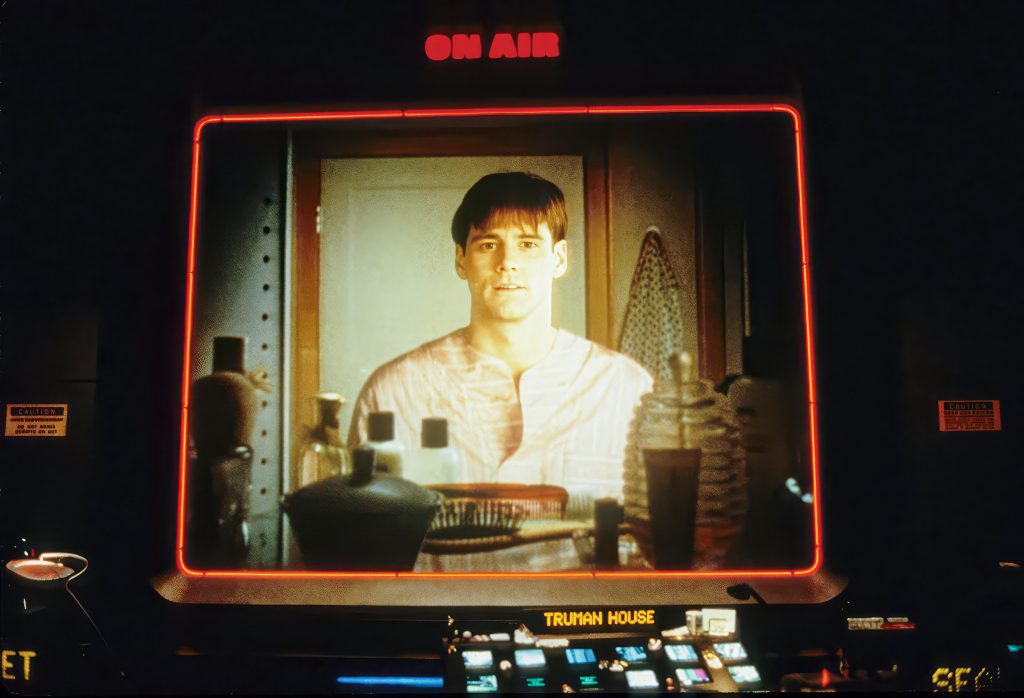
The practical embodiment of this theoretical framework in the film is best illustrated by director Christof’s approach. When Christof, who directs Truman, joins a live broadcast, the reporter thanks him, saying, “We all know how jealously you guard your privacy.” This contrasts sharply with Truman, whose entire life is constantly recorded through hidden cameras, showing how authority’s true power lies in invisibility. While Christof’s role closely resembles the central observer in Bentham’s Panopticon, Truman does not police his behavior, because he is unaware of the cameras watching him and does not feel the oppressive gaze.
Throughout the film, whenever Truman experiences anger or emotional crises, his wife Meryl doesn’t offer support; instead, she suggests, “You know, you really ought to throw out that mower. Get one of those new Elk Rotaries.” In our world, it’s very easy to become a consumer because solutions are often presented as products that require ongoing purchase, rather than through access to healthcare and therapy. Director Christof deliberately caused Truman to lose his father at sea to evoke fear of the ocean, thereby trying to stop Truman from traveling abroad.
In a scene, Truman sits alone on the beach, gazing at the sea, when a flashback shows his father disappearing during a storm at sea. It is unclear whether Truman genuinely remembers this event, but it can be seen as the message the director aimed to communicate to the audience.
When the flashback concludes, it begins to rain just enough to soak Truman. The cloud seems to follow him everywhere. However, this unusual sight doesn’t frighten Truman; instead, it boosts his confidence, helping him find the courage to escape. When he gets back home, he eagerly tells his wife about his plan to go to Fiji. This scene highlights how little the director understands Truman. The director believed the rain would trigger Truman to remember his father’s death and become scared, but Truman’s immediate thought was to cross the ocean and reach Fiji. By the end of the movie, despite all the obstacles in his way, Truman finds a boat and begins his journey alone.
He believes he can finally realize his dream of going to Fiji, but the director is resolute in preventing him. Truman reaches the end of the artificial sea where his boat has been sailing and crashes into the sky-like set. His face shows a mix of surprise and disappointment. At that moment, the director decides to speak to Truman directly for the first time. Truman cannot see him, but the director’s voice comes from the sky. This serves as proof that the director views himself as Truman’s creator. When the director tells Truman, “There’s no more truth out there than there is the world I created for you.” Truman’s shocked response is, “You never had a camera in my head.” This line explains why the flashbacks in the movie don’t always align with Truman’s decisions.
“The film’s true conclusion lies in the scene with the two security guards who cheer for Truman’s escape, only to ask, ‘What else is on?’ the moment the screen goes dark. This ending encapsulates the film’s central thesis, illustrating Baudrillard’s assertion that meaning implodes within an endless media flow where a war report and a commercial are consumed with identical detachment, and the audience remains thoroughly desensitized to reality.
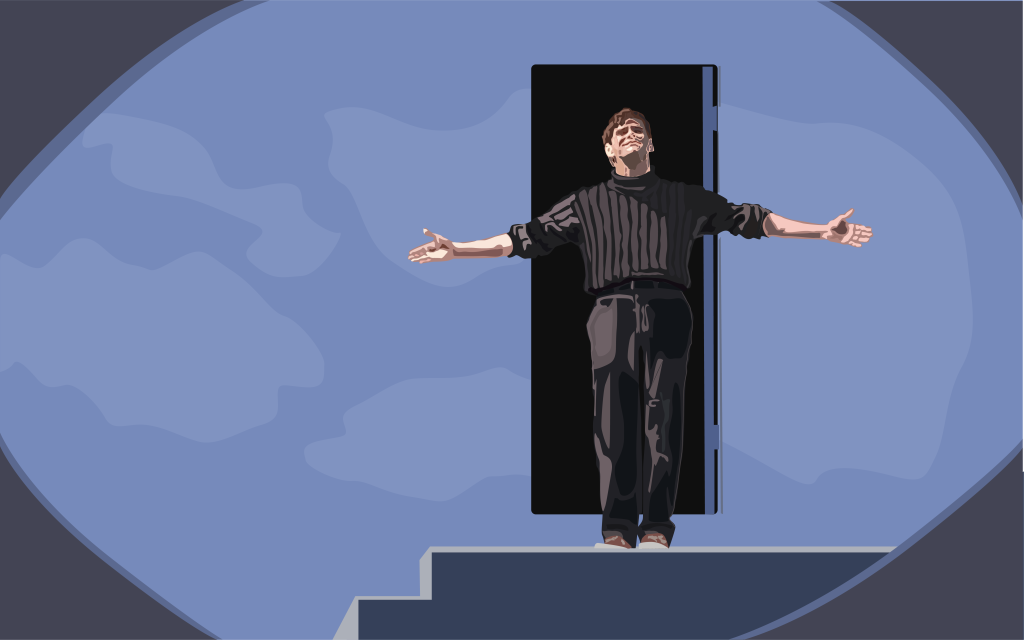
Truman steps off the stage through the black door to seek reality, illustrating a poignant act of courage. Despite the fear and chaos that may await outside, he chooses to forge his own path. This moment highlights the tragic heroism in facing the unknown, as the world of simulation relies on the abandonment of such courage. The system endures only when individuals cease resistance, accept their predetermined roles without question, and survive solely through consumption.
We never see what happens to Truman afterward. He spends his entire life watched by cameras and desperately tries to escape that reality. If the film had shown his actions after he walked through the door, it wouldn’t have conveyed the profound experience of leaving the simulation.
What happens next is unique to Truman himself, making his story singular. The film’s true conclusion lies in the scene with the two security guards who cheer for Truman’s escape, only to ask, “What else is on?” the moment the screen goes dark. This ending encapsulates the film’s central thesis, illustrating Baudrillard’s assertion that meaning implodes within an endless media flow where a war report and a commercial are consumed with identical detachment, and the audience remains thoroughly desensitized to reality. Throughout the film, viewers are engaged with Truman’s life, curious about his fate, but once his life is no longer broadcast, he seems to vanish, as if he never existed. For the audience, the show simply becomes entertainment.
“You never had a camera in my head.” This line defines the limits of the simulation. While power can confine the body, simulate environments, and influence surroundings, it can never fully access the human mind’s privacy. Truman’s triumph wasn’t just about leaving that door; it was about the thirty years he spent under constant surveillance, during which he created a genuine sanctuary within his mind-a place even the creator of his world couldn’t invade.
In a world filled with simulacra, Truman’s unbreakable mind is the only thing that keeps meaning alive. Christof is correct about one thing: the outside world is also fraught with dangers. It’s true that the outside isn’t as safe as Seahaven; it’s chaotic and unpredictable. As Baudrillard describes, it’s the “Desert of the Real.” Maybe Christof’s prison isn’t Seahaven itself, but the cozy living rooms of those of us who prefer to change the channel rather than face the truth and question the world around us.
Just as Christof persuaded Truman that he was experiencing a natural flow of events instead of a world of illusions, the film persuades us of the same idea. While observing Truman’s artificial world, we, like visitors to Disneyland, are under the illusion that our own world is authentic.
Truman woke up and left. But what about us? We’re still on air…
Son İçerikler