Heist of Monopoly: A Stolen Story
Sıla Gündüz
“Imagine a board game whose purpose is to make the player question the inequalities created by private property in the means of production and the order established by capitalism. Then, it becomes part of a global capital cycle with over 270 million copies sold. Here it is: the game that, over the years, has transformed into one of the most profitable products of the very system it criticizes The Landlord’s Game! known to us as Monopoly.”
The Landlord’s Game was initially designed to explain to the public the teachings of American economist and philosopher Henry George, who lived in the 19th century, which seemed outdated. The game aimed to reveal how the aristocratic class, that is, landowners, could earn unjust profits without any effort, simply by renting out their land, and how this situation disempowered and impoverished society. At the core of everything was the Industrial Revolution, which opened the doors to a new era in world history. A century before The Landlord’s Game, in the 18th century, the emergence of steam engines increased production capacity and speed. This led to a greater need for human labor on the production line.
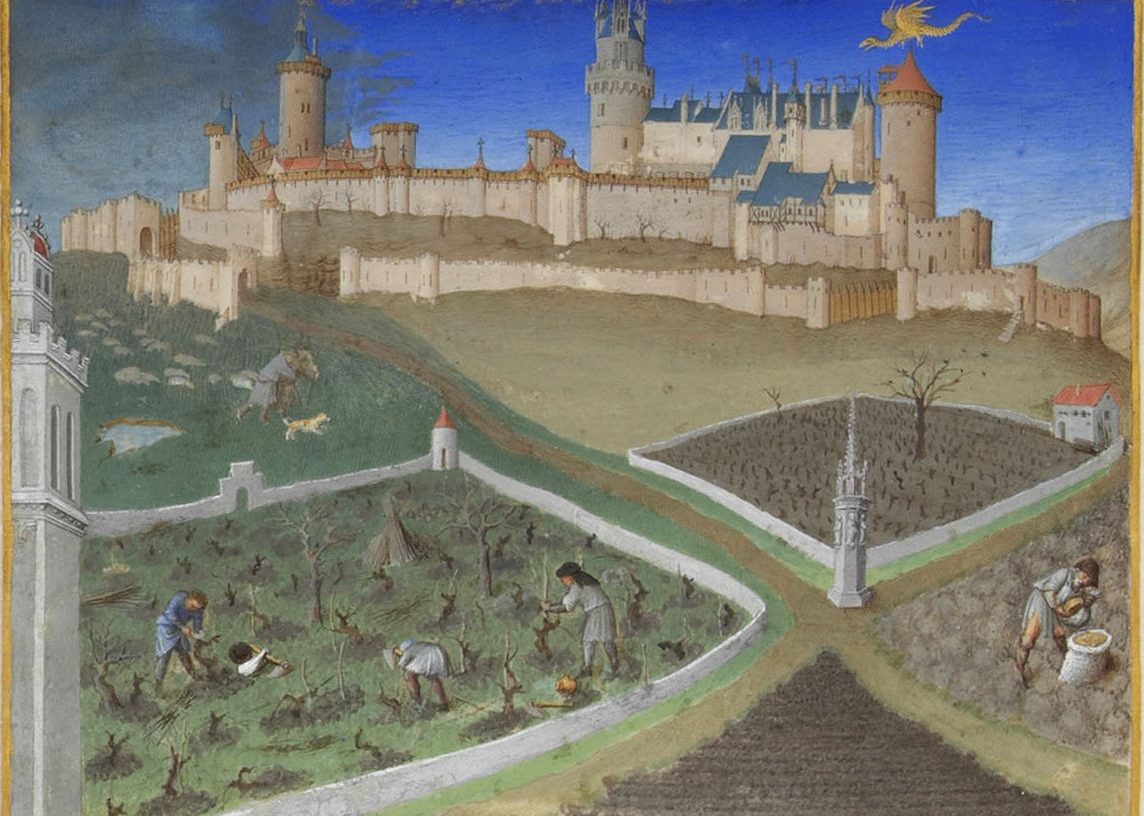
The new era raised an additional question mark for factory owners: “Who will work in the factories?” The invention of massive production lines and brand-new machines quickly led to a shortage of the urban workforce. In response, the wealthy began purchasing land in rural areas where peasants lived and started fencing off the properties. Meanwhile, peasants who continued agricultural activities on shared lands lost their land through the enclosure method called “fencing” leaving them with no choice but to work in factories. Due to this situation, in just 20 years, 150,000 villagers migrated to Washington, D.C., doubling the city’s population.
This rapid population growth brought with it outbreaks of infectious diseases, housing problems, and unemployment. During this period, since taxes were levied per person or on consumption, and there was no income tax as we know it today, factory owners earned millions of dollars annually and paid not a single cent in taxes to the government. Because the government did not collect taxes on production, all tax burdens were placed on consumption and customs duties. In this era, when mercantilist trade was dominant focused solely on selling produced goods by restricting foreign trade high customs tariffs protected large companies. These companies were shielded from foreign competition.

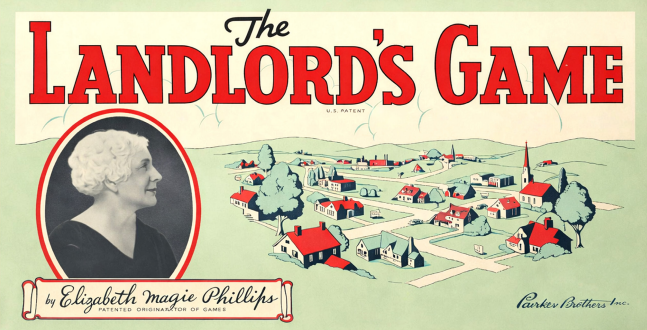
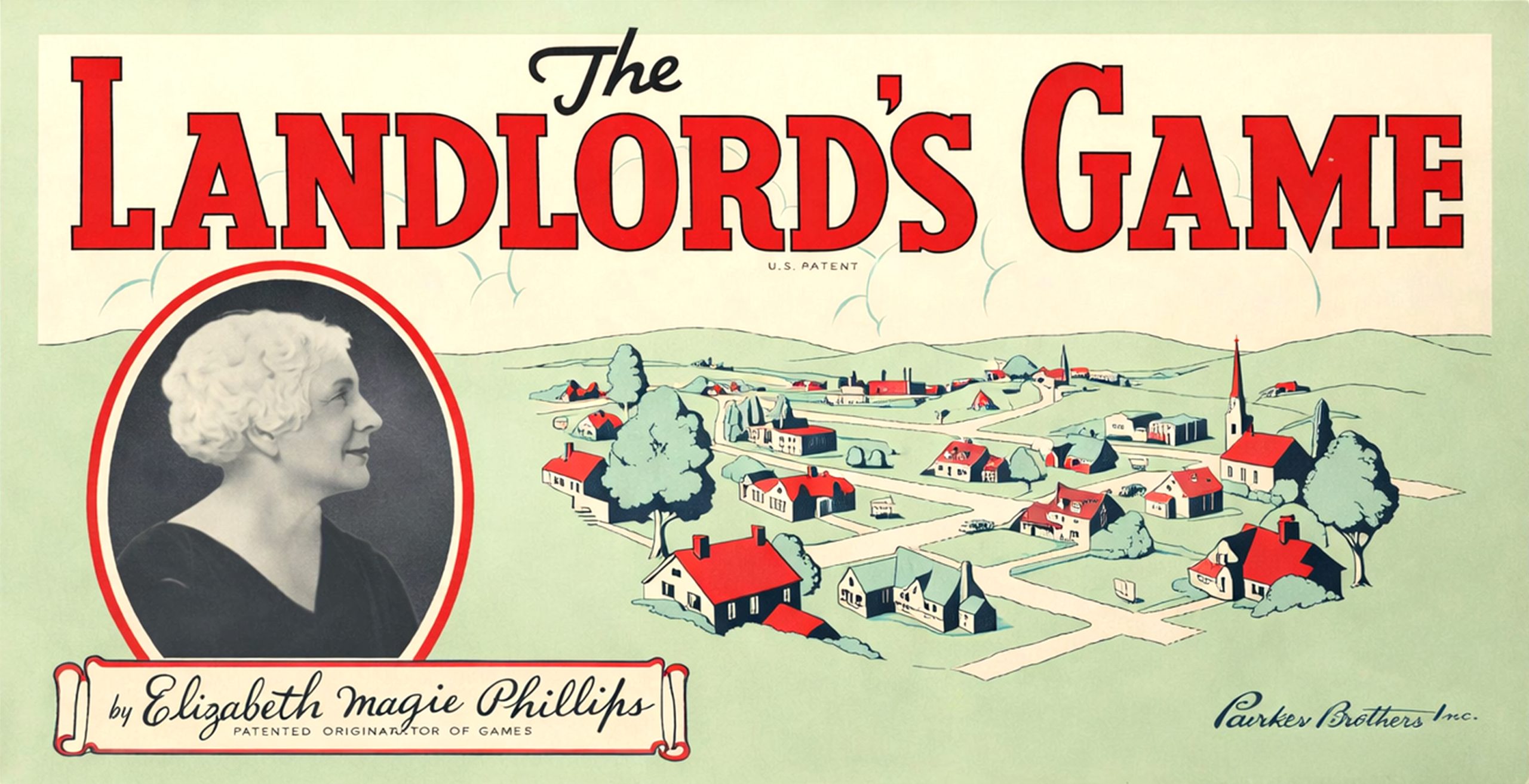
Elizabeth Magie (Lizzie Magie)
This tax system further facilitated conditions for big corporations, allowing monopolistic firms to raise prices at will. Landowners who enclosed land and seized it either used it for their own production or sold it to the public at exorbitant prices. Workers with nowhere to live had to accept high rents, spending all their resources just to survive. Perhaps this was because Henry George’s ideas seemed outdated. Witnessing the unchecked growth of corporations and the people’s existence in poverty, economist George began to envision a system where, contrary to popular belief, the people were not victims. According to his philosophical principles, resources bestowed by nature such as water, air, and land could not be owned by any individual or institution. Land was a resource that people had to actively use in order to sustain their lives. Therefore, the use needed to be regulated by a fair system. This way, everyone could benefit from the land, and no one could unjustly fence off the land. George called this approach the “Single Tax” system.
“Maggie thought she was approaching the problem incorrectly and realized that the real question should be, ‘How can I teach without having people read books?’”
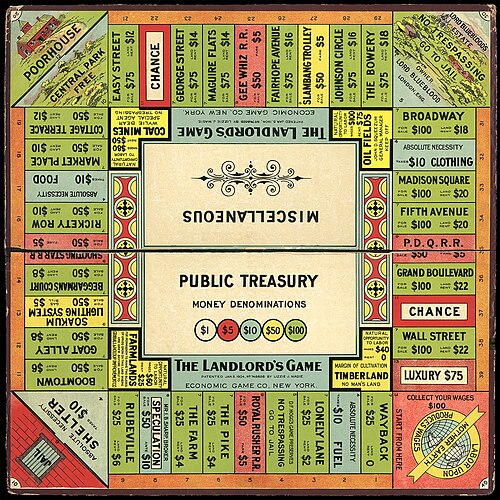
1906 yılında yayımlanan The Landlord’s Game oyun tahtası
According to George, the state did not own the land. However, to ensure equality, the revenue generated from the land also needed to be regulated. If only the base value of the land excluding buildings, factories, or shops was taxed, the state could properly fulfill its contract with society. However, George’s ideas were not aligned with the interests of the wealthy and the state of that era, which existed to protect their rights.
In this society, where literacy rates were quite low, the Single Tax System was supported mainly by academics and a limited segment of people who could see the entire economic order. George emphasized in his books and public speeches that a very large portion of the land belongs to the wealthy, and that the state can survive simply by taxing the rich. The excess revenue from these taxes could be equally redistributed to all citizens under the heading of universal basic income. Moreover, this system would prevent anyone from occupying land without a purpose; otherwise, they would incur financial loss, and the land would naturally be transferred to someone who truly uses it.
Henry George’s supporter, American writer and feminist activist Maggie Lizzie, believed that the Single Tax System could transform their world into an egalitarian one. Rejecting the oppressive norms of her time, Lizzie centered her feminist struggle on economic change. She was a highly proactive and significant figure of her era, conveying her ideas to the public through poetry, articles, plays, group discussions, and comedic elements. Through her work, she aimed to show many women that they were not only destined for household chores but also capable of pursuing fields such as politics, science, and economics. Maggie, with an excellent sense of her society’s pulse, built strong bonds with the lower classes, contrary to the prevailing narrative of intellectuals of her time. She believed she played an important role in building a society without poverty, where people wouldn’t have to work their entire lives just to survive.
In this context, she moved to Washington D.C. in 1890 to advance her struggle. She became a founding member of the Washington Women’s Single Tax Association, established under women’s leadership. To draw attention to the issues of the system, she took action by placing a newspaper ad under the name “A Young American Slave,” selling herself as a form of protest.
Maggie realized after a few years of working with the association that she wasn’t reaching enough people. She began to look for different ways to connect with the working class. In a savage capitalist society where literacy rates are so low and the average working day exceeds half a day, she found that people couldn’t read books, or, even if they could, they didn’t have the time or economic means to do so. Soon, Maggie thought she was approaching the problem incorrectly and realized that the real question should be, “How can I teach without having people read books?” Capitalism, which turned the private ownership of the means of production and monopoly into rules, moves, and outcomes, emerged as a result of such a problem. Maggie thus condensed into a board two different versions of the game: one criticizing the contradictions of the system and the other based on Henry George’s Single Tax System and the social distribution of economic gains.
According to this, either one player or all players would win. The version where only one player wins is called The Future I Fear, and the other is called The Future I Dream. In the fi rst version, where only one player wins, players try to monopolize, so the other players become opponents rather than teammates.

One of the The Landlord’s Game variants played among Quakers; an archival photograph from the Harvey family collection.
Each player buys the land they pass through, then builds on these plots, thereby increasing the money they will collect from other players. The game then enters an endless cycle that lasts for hours. For Maggie, even this length is significant in itself. In this version, as the game progresses, inequality deepens, and the gap between the winner and the loser widens progressively.
“This game, which gradually lost its originality over time, was one day noticed by Charles Darrow, an unemployed marketer, while it was being played on the street by Quakers. Darrow’s friend, impressed by the game, excitedly goes home and mentions it to Darrow.”
In the Future I Dream version, there are rules in which everyone wins and a single tax system applies. This time, the bank represents the state. When a player wants to build a structure on a property, they must pay a certain amount to the bank each turn. Other players who land on this building pay rent to the owner. When the bank’s cash box is full, the accumulated money is distributed equally among all players. In this system, where there is continuous money circulation, everyone gains even if progress is slow. To end the game, all players must at least double their initial money.
The game is designed to make people think, but when it is presented to the public, it doesn’t cause the kind of major breakthrough Maggie was expecting. It doesn’t make headlines or become a topic for the general public. People start playing the game at home, among small groups of friends. Over time, the game, especially on college campuses, circulates from hand to hand, sparking discussions among students.
Thus, The Landlord’s Game spreads quietly but relentlessly, reaching as far as the East Coast of America. After a while, the game also gained popularity among Quakers, a religious community dedicated to teaching God’s word. However, since board games had not yet become an industry, the games were not mass-produced; they were copied by hand. They were passed from person to person. This situation led to the emergence of different versions of The Landlord’s Game over time. The game began to be played with different neighborhood names, varying bank rules, and local interpretations. The each reproduction, the rules stretched, diversified, and transformed a little more.
This game, which gradually lost its originality over time, was one day noticed by Charles Darrow, an unemployed marketer, while it was being played on the street by Quakers. Darrow’s friend, impressed by the game, excitedly goes home and mentions it to Darrow. That evening, they try playing the game with the Future I Fear version. Darrow literally falls in love with the game, and afterward, he and his friend create an exact copy of it at home. The copy they prepared is so similar to the original that even the mistake made when writing the name of the neighborhood where they found the game, Marvin Gardens, is preserved exactly.
The next morning, Darrow and his friend go to Parker Brothers, now part of Hasbro Games, one of the world’s largest game companies, to present the game. Parker Brothers likes the game very much, purchases it from Darrow, and begins marketing efforts. However, the founders of Parker Brothers never fully trusted Darrow, and they even believed that Darrow was not the true owner of the game. This suspicion is not limited to the founders; many people around them also find the situation contradictory and repeatedly warn Parker Brothers. Ignoring these warnings, Parker Brothers tries to cover up the evidence. After a while, during their research on The Landlord’s Game, they come across a patent that Maggie obtained 14 years earlier. To avoid future legal issues, they go to Maggie. They promise not to deviate from the original purpose of the game, and, in exchange for paying her $500, they buy the patent from the original owner. In line with their promise to Maggie, they initially released the game in its original form and maintained this original structure for several series.
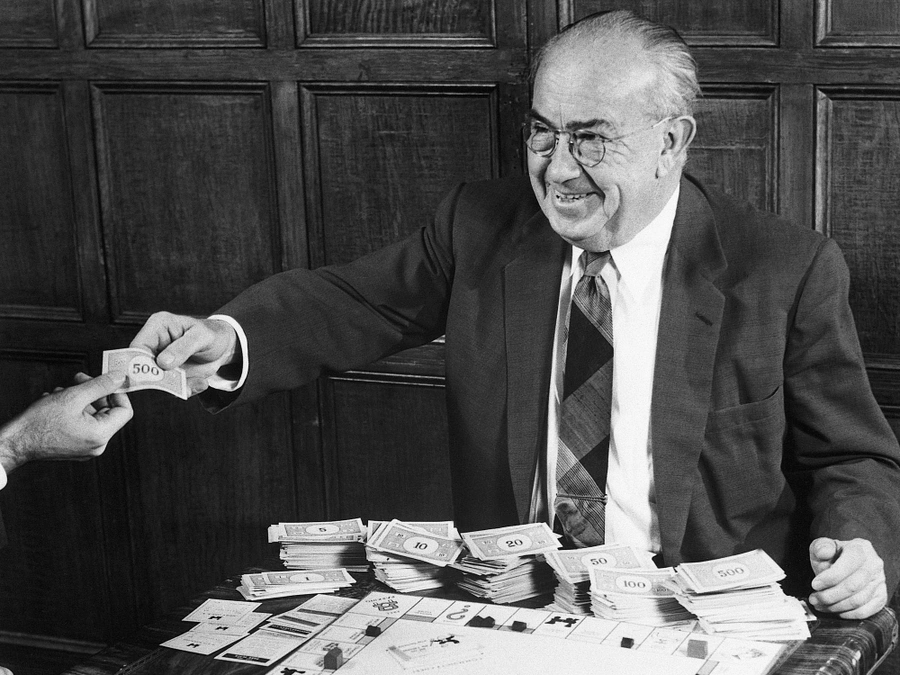
However, Parker Brothers’ promise to Maggie was limited only to these few series. Since no marketing efforts were made for the games produced, they gathered dust on the shelves. In contrast, the version of Monopoly that depicted capitalism, called The Future I Fear, was released alongside Darrow and received a massive investment and was officially registered. The company erased the game’s true origins and Maggie’s existence. The marketing department promoted the story that the game was invented by a desperate man, Darrow, who lost his job during the Great Depression, in his basement to entertain his wife and children, as an “American Dream”. When Monopoly became the best-selling board game in history, Charles Darrow, known as the “original inventor’ of the game, was introduced to the media as the first person to become a millionaire by designing a game. He spent the rest of his life in luxury.
“Maggie, who sold her patent for only $500 and, under the agreement, did not receive any royalties, could not earn a single penny from the game’s global success. When she passed away in 1948, despite seeing that the game she designed to warn people had become a ‘symbol of greed,’ she died as a strong woman who refused to give up and continued her fight”
Maggie, who sold her patent for only $500 and, under the agreement, did not receive any royalties, could not earn a single penny from the game’s global success. When she passed away in 1948, despite seeing that the game she designed to warn people had become a “symbol of greed,” she died as a strong woman who refused to give up and continued her fight.
Her obituary in the press did not mention that she was the inventor of the game. The purpose of The Landlord’s Game and the set of rules called the Future I Dream, which reflects Henry George’s theoretical work based on common profit and equal sharing, was completely removed from the rulebook by Parker Brothers. All that remained was the Future I Fear, a simulation of savage capitalism where all players try to ruin each other. Today, Monopoly, which millions of people around the world enjoy playing, was actually the economic system Maggie wanted to warn people about.
The game, originally designed to criticize landowners’ unjust profits and the evils of monopolies, had turned into a tool that teaches people “How to become a ruthless real estate millionaire?” This story would probably have been lost in the unknown parts of history forever. However, in the 1970s, an economics professor named Ralph Anspach designed a game called “ Anti- Monopoly” to criticize the capitalist values of Monopoly…
Anspach was surprised when he faced a copyright lawsuit and began a thorough investigation. Through years of legal battles and meticulous detective work, he discovered Maggie’s story. Today, while trying to spread Henry George’s ideas of equal sharing, Maggie’s story -full of strugglescontinues to shed light on society, even decades after her death, as the creator of the most iconic symbol of capitalism.
Son İçerikler